Adoption Healing: A Book Review
 From the Journal of Korean
Adoption Studies
From the Journal of Korean
Adoption Studies
Review by Jane Jeong Trenka
Some books are so good that you can even forgive your friend for
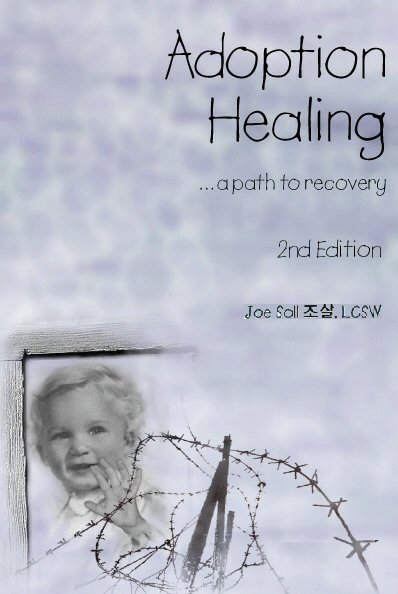
“borrowing” your copy and never giving it back. Adoption Healing … a
path to recovery by Joe Soll is one such book.
Adoption Healing, a self-help book, has been passed around among the
adult internationally adopted Koreans who have returned to South
Korea, and who indeed rely on self-help while living in a country
where gaining access to services in their own languages is
difficult.
This book is the gift that “lifers”, Korean adoptees who have
returned to Korea, give to one another after the initial fun of
Seoul wears off and we are left with the hangover of too many late
nights in Seoul’s student and foreigner districts, too many ruined
intimate relationships or none at all, limited employment
opportunities, and the mix of hope and despair that comes from
living in a country where we are no longer recognizable to Koreans
as Korean.
Our foreign mannerisms, shattered tongues, and imagined histories
have been known to elicit pity and shame from South Koreans. How we
are portrayed and perceived, and how we want to be portrayed and
perceived, therefore, becomes a heated topic of conversation. How
must we appear in order to get what we need — whether recognition
from the South Korean government, acceptance in society, or more
personally fulfilling reunions? Should we try to appear “successful”
and “well-adjusted” or even “angry and ungrateful”?
These kinds of one-sided false selves have their roots in the
adoptee’s understandable fear of abandonment, Soll tells us as he
gently guides us into living more “authentic” lives. He explains
that adoptees’ inner worlds are shaped by mixed messages that force
them “to choose between the socially unacceptable reality they
experience and a distorted, but socially sanctioned, interpretation
of their reality as determined by others.” “This book,” he writes,
“is about the realities of adoption and the realities of the inner
world of the adopted person.”
Hope for Individual Change
Soll — a licensed social worker, psychotherapist, and American
domestic adoptee — simply and concretely describes the adoptee’s
inner world in 26 concise chapters. In each chapter, he gives
examples of “Myths” and “Facts” about adoption, a summary of the
information in the chapter, an exercise to write or do mentally, and
a grounding “Experience of the Moment” designed to be read after the
exercise. Always with the whole “triad” of adoptee, natural parents,
and adoptive parents in mind, Soll ends the book with appendices
that include lists of “What Adoptees Do Not Wish to Hear” and “What
Natural Parents Do Not Wish to Hear,” and “What Adoptive Parents Do
Not Wish to Hear.”
Readers of Nancy Newton Verrier’s The Primal Wound: Understanding
the Adopted Child will be familiar with some of Soll’s fundamental
beliefs about adoption, beginning with, “The mother-child
relationship is sacred and the separation of the mother and child is
a tragedy for both.” Soll considers thus “primal wound” to be the
first trauma. He considers the second trauma to be the verbal
acknowledgment to the adoptee that she is adopted. (It’s likely that
many transracially and internationally placed adoptees, older
adoptees, and children adopted into families where there were older
siblings present, did not need to be told by their adoptive parents
that they were adopted.) He considers “fracturing” to be the third
trauma.
Fracturing is an acronym for the simultaneous feelings that the
adopted child is surrounded by: Frustration, Rage, Anxiety,
Confusion, Terror, Unrest, Regret, Inhuman, Neglected, Grief.
Fracturing occurs at the “age of cognition,” usually around six to
eight years old. At that time, adoptees are able to start thinking
about their own adoptions. They do so in the face of conflicting
messages, for instance, “Happy birthday! / This is the day you were
surrendered.” Faced with unresolvable messages that cannot be
integrated into her reality, the adopted child will resort to her
own logic about her abandonment. If not validated, the child
represses horribly painful emotions, after which she is actually
unaware of such emotions and suffers a “psychological death.”
“It is much healthier to deal with truth,” writes Soll, and indeed
he puts every painful card out on the table: “It’s normal for
adoptees to be in crisis during adolescence.” Adoptees, because of
not knowing their origins, finds it difficult to imagine themselves
getting older. They have more difficulty maintaining healthy
intimate relationships. They have a harder time than non-adopted
people finding careers that suit them. “Many people who appear happy
are just (unconsciously) hiding pain.” He likens the material in his
book to an emotional root canal – painful, but necessary.
“I am not happy about what I have written here, but it needed to be
written” writes Soll, but, “it needs to be recognized as knowledge
that can help heal those already hurt and help prevent some of the
hurt for those who may become involved in or impacted by adoption.”
As a self-help book, Soll’s description of adoptees’ inner worlds,
while not exactly feel-good material, gives adoptees and the people
who care about them a lot to consider and reflect upon. I was
personally surprised by the power of Soll’s simple affirmations and
visualization exercises. Like another reader, I found them to be a
little weird at first, but I soon realized that they are very
worthwhile. One exercise I particularly liked is this:
Light a candle and then let the flame represent
the burning desire to have something that doesn’t exist anymore,
like wanting to go back and this time be raised by your natural
mother. When you are ready to stop wanting something that is
impossible to happen, blow out the flame that holds you back from
living your life, that burns you with a desire for the impossible.
Hope for Systemic Change
The book offers help like this on an individual level, and also
suggests systemic changes in the practice of adoption. To start
with, all members of the “triad” suffer huge losses — whether
infertility, the loss of a child, or the loss of the mother — and
these losses should be truthfully addressed instead of whitewashed
with either platitudes (“You were chosen.”) or completely denied
(“Get over it.”). As far as specific recommendations on policy, Soll
includes the following:
1. Every effort should be made to keep children with their birth
families, followed by the extended family.
2. All adoptions should be “open,” meaning regular visits should be
held with the natural mother throughout childhood and adolescence,
even if the visits have to be supervised.
3. Children should keep their names and heritage.
4. Adoptees should have periodic psychological development
“checkups.”
In short, Soll is a big fan of speaking the truth and dealing with
reality. He is completely in the camp of open records. “A reunion
should preferably take place before puberty,” writes Soll, saying
that a reunion between the ages of six and eight can help prevent
the “fracture” and even bring adopted children closer to their
adoptive parents. He sees closed records as a symptom of the lack of
respect for adoptees, natural parents, and adoptive parents.
Implications for International Adoption
Soll’s work seems to be mainly addressed to American domestic
adoptees, but it also has huge implications for the system of
international adoption, considering that many adoptive parents
choose international adoption over domestic adoption for the very
reason that they do not want to have contact with a natural mother.
Natural mothers of international adoptees are at the time of this
writing almost hopelessly separated from their children by
geographic distance and hidden paperwork. If adoption agencies took
Soll’s advice to heart — keeping adoption records open and reuniting
adoptees with their natural mothers for regular visits in childhood,
for the benefit of the child — would there be so many international
adoptions?
What Soll proposes to be necessary for a healthy adoption culture
would make international adoption even more dreadfully expensive and
inconvenient for adoptive parents. If all members of the triad were
guaranteed contact, agencies would be forced to give accurate social
histories of children. Honesty would be enforced. Perpetrators would
be caught. Governments would have to freely give out visas to
non-white people, often impoverished, from non-Western countries or
countries of the global south. People would have to see
natural mothers as real people — not whores or saintly human
gift-givers. Natural parents might get to speak, and the literature
on international adoption would have to include their voices.
Adoption agencies would have to find a way to help bridge
differences of language and culture in ways that are personally
meaningful, instead of encouraging adoptees to relate to their
cultures of origin as tourists and consumers.
The financial cost for international adoption agencies to heed
Soll’s advice is incredibly high and may even be destructive to the
system of mass international adoption itself. But the human cost of
not heeding his advice is even higher. It is simply the reality of
today, reflected in the high rates of suicide, incarceration, and
mental illness amongst adoptees, as well as “disrupted” adoptions.
Additional Challenges for International and Transracial Adoptees
Soll, however, does not specifically address the additional
challenges that internationally and transracially adopted people
face, including racialized violence in their adoptive countries and
the language barrier if they are reunited. Many internationally
adopted people, who as of now have little hope of reunion with their
natural families, may be reunited instead with their original
countries and culture. (The “mother country” is routinely proffered
to adopted Koreans as a substitute for the actual mother.)
Yet we also need a way to cope with feelings of abandonment by
entire countries, governments, and cultures. Extending Soll’s ideas
about individual reunions between mother and child to social groups,
it’s possible to guess that what is behind the drive by some adoptee
groups to represent themselves as purely “Successful!” to the Korean
public is actually the fear of a second abandonment — not by a
mother — but a country. If they could see who we really are, in all
our complexity, would they still love us?
In the midst of so many internationally and transracially adopted
people of color checking the “white” box on U.S. demographic forms —
lying to themselves and creating a false self for the world to see —
adoption agencies should seriously consider whether they are helping
adoptees lead “authentic lives.” When the adoptee is denied the
opportunity to lead an authentic life because of enforced secrecy
and lies, it impoverishes not only the adoptee, but also the natural
mother and the adoptive parents.
Reality and Recovery
In The Will to Change, bell hooks summed up why people impacted by
adoption need to heed Joe Soll’s advice — no matter how
uncomfortable, inconvenient, or expensive: “Anyone who has a false
self must be dishonest. People who learn to lie to themselves and
others cannot love because they are crippled in their capacity to
tell the truth and therefore unable to trust.”
Adoptees’ lives, emotional health, and even our ability to love our
parents are entangled with the very policies and conditions that
created us. What have those conditions been? Overwhelmingly, those
conditions have been filled with lies – our own lies, family lies,
agency lies, government lies.
For those adoptees working to make positive changes in these very
adoption policies that shaped our lives, it is essential to tell the
truth, both personally and politically, to ourselves and to
our loved ones. For all adoptees, it is important to acknowledge our
complex realities so we can live in a joyful way, so that we can
make conscious decisions and, as Soll says, fully experience the
world, not just exist in it. Joe Soll offers us paths that we may
explore on our journey toward healing, health, recovery, and love.
This is an important book for adoptees, adoptees’ partners and close
friends, natural parents, and adoptive parents. Soll’s
straightforward approach and clear organization makes it possible to
do the emotional work without being burdened by a text that is too
long or laden with jargon. Parts not of interest can be easily
skipped over and returned to later. An added bonus of this book is
that the writing is simple enough to be understood by people whose
speak English as a foreign language.
Although it has been nine years since it was first published,
Adoption Healing deserves continued and widespread recognition.
After all, as librarians say, “Every book is a new book until you
have read it.” May you enjoy your copy, and pass it on.